The Grain Mill is an Essential Self-Reliance Appliance
The grain mill is an essential part of the homestead kitchen. If you don't have one of these nifty little tools, you're not only missing out on some of the most fabulous-tasting flour ever, you're also missing out on the best nutrition out there.

What Do They Do?
These mills make flour out of not only wheat, but also other grains such as oats, kamut, rye and triticale. It will also make flour out of legumes, such as lentils and other beans. You can make delicious breads with a wide variety of freshly ground flours.

Why You Need A Grain Mill
We're talking serious nutrition here. The flour you buy in the store - even the whole wheat kind - is dead. Once ground, wheat loses all of its nutrients within 12 hours.
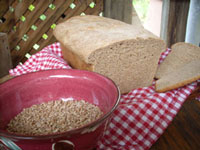
Ground wheat left out longer than a week will even become toxic (always either freeze your freshly ground flour or better still, grind just enough for your daily use). To combat this, manufacturers will add preservatives and vitamins to store-bought flour and breads.
These preservatives wind up in your body and stay there for a long time. You can avoid these scary chemicals by grinding your own fresh flour in your own grain mill at home to make your own delicious bread. Besides, wouldn't it make more sense to get all of those great nutrients right up front by grinding your flour fresh daily?
The Different Mills Available
When considering a grain mill to purchase, you have the choice between a grinder that runs on electricity or one you work by hand.
Obviously, the electric mill is easier to use, but a hand mill would be useful to have when the power goes out, or if you choose to go off grid.
If you plan to stock up on bulk grains – and I highly recommend you do – it would be wise to invest in a hand-operated mill as well as an electric one.
Different mills use three different ways to convert your grains into flour:
- Stone
- Burr
- Impact
I'll discuss each type.
Older Than the Hills - The Stone Grinder
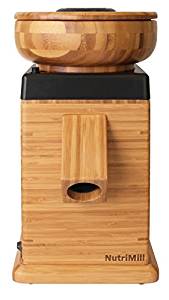
Stone grinders like this NutriMill are a wise investment that will last you for years.
The technique of grinding wheat between two stones has been around for centuries, and until recently, it was the only way.
Rub one stone against another, stationary stone and voila! You get flour. Until a few years ago, the grinding stones were about two or three feet across and incredibly heavy.
They were turned either by water, windmills, animals or people
unfortunate enough to be dragged into this kind of work – usually
slaves.
Nowadays, the stones aren't stones at all, but instead an incredibly hard material about three inches in diameter. It makes the grinder lighter – relatively speaking.
The nice thing about a stone mill is it will last a long time. Unlike the impact grinders, a stone grinder can be adjusted to different settings, such as cracked wheat or fine flour.
Also, it is much safer to use with wheat that hasn’t been completely cleaned of small, grain-sized stones and bits of metal. If you plan to grow and harvest your own wheat, the stone grinder is probably the option for you.
The downside of stone grinders is they are larger and bulkier and grind more slowly. Also, you shouldn’t grind seeds or nuts with these as the stones will become “loaded” and not work.
The Burr Grinder
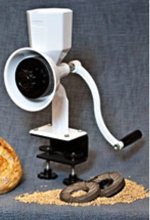
Burr grinders like this Wondermill Junior Deluxe Hand Mill can grind oil-bearing seeds and coffee as well as grain.
The burr grinder uses steel teeth that grind the grain into flour.
On the plus side, you can use these to grind oil bearing seeds, unlike the stone or impact grinders.
On the downside, it won't grind as finely as a stone grinder – although the grind is fairly close.
The Wondermill Junior Deluxe Hand Mill is an excellent hand-operated burr grinder.
Impact Grinders
These use blades placed in circular rows on metal wheels. The wheels are aligned so the blades mesh together, running extremely close, but never touching. Running at an incredibly fast speed, the two wheels crush the grain and convert it into flour.
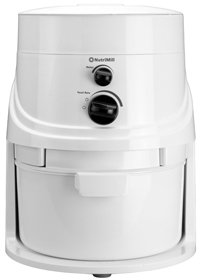
Impact grinders like this NutriMill High Speed Grain Mill work well and are a good, if noisy, low-cost option.
The nice thing about these mills is they are fairly light and will fit just about anywhere. The NutriMill High Speed Grain Mill is one such mill (you can find one here). It can grind not only wheat but also legumes and rice.
On the downside, the blades are fragile, and small rocks or pieces of metal can damage the wheels. If you have an impact mill, be sure to use only grain that has been well-cleaned (for example, commercially purchased grain).
You won't be able to crack wheat with an impact grain mill, and let's be frank: they're noisy little cusses, but for the price, they can't be beat.
Related article: How to make your own yeast.


Recent Articles


-
What Does Electrotherapy Do?
Sep 08, 22 04:05 PM
 What does electrotherapy do? Look at it as a safer way to manage either temporary or chronic pain.
 -
Why Pine Needle Tea Is a Must Have in Your Preparedness Pantry
Sep 01, 22 06:02 PM
 Pine needle tea is a must have in your preparedness pantry. It's the best way to eliminate any harmful spike proteins you've been exposed to.
 -
Is Sourdough Gluten Free?
Aug 31, 22 02:55 PM
 Is sourdough gluten free? The short answer is no, if you have a several allergy to wheat or gluten, but it is more digestible.

New! Comments
Have your say about what you just read! Leave me a comment in the box below.